


Why This Warehouse Documentation Clerk Job in Joburg Is Worth a Second Look
Table of Contents
There is a quiet kind of work that keeps global trade moving, and most people never think about it until something goes wrong. A container missing its paperwork. A delivery that cannot be traced. A stock count that does not match what is actually sitting on the shelf. Behind every smooth shipment, there is someone making sure the documents, the systems, and the physical goods all agree with each other. That is the heart of a warehouse documentation clerk job in Joburg, and right now, one of the world’s largest shipping and logistics companies is opening its doors to South Africans who want exactly this kind of steady, meaningful work.
Johannesburg has always been a city built on movement. Goods pass through its warehouses on their way to shops, factories, hospitals, and homes across the country and beyond. For someone looking to build a career in operations, administration, or supply chain, this is not just another vacancy notice. It is an invitation into an industry that will not disappear, because as long as goods need to move, someone needs to track them.
Stay Connected:
Follow VisionSoul on social media and join our WhatsApp channel for the latest updates.
What This Role Actually Involves
The position sits inside a warehouse environment based in Johannesburg, and it is a full-time, site-based role working day shift hours. The company behind it operates on a global scale, connecting supply chains across continents, yet the daily work itself is grounded and practical. It is less about grand strategy and more about precision, consistency, and care with detail.
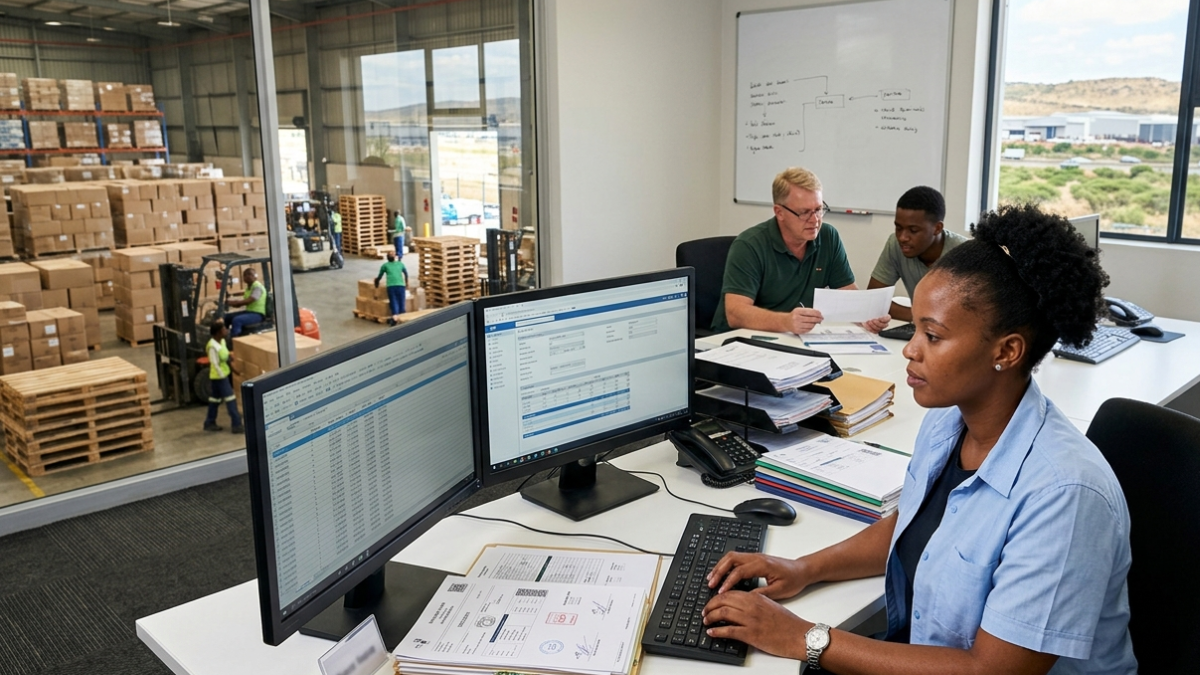
At its core, this warehouse documentation clerk job in Joburg exists to keep the administrative side of a busy warehouse running without friction. That means maintaining Proof of Delivery records so that every shipment can be accounted for, reconciling purchase orders and invoices so that what was ordered matches what arrived, and preparing reports that give the operations team a clear picture of stock levels and order progress at any given moment.
Inventory work forms another major part of the role. Cycle counts and stock takes need to happen regularly, and when the physical stock does not match what the system says, someone has to work out why and fix the discrepancy. This is detective work in its own quiet way. It requires patience, an eye for pattern, and the discipline to follow a problem through to its actual cause rather than guessing at a quick fix.
There is also a technology side to the job. The successful candidate will work inside a warehouse management system, entering data related to stock movements, receipts, and dispatches. Accuracy here matters enormously, because a single incorrect entry can ripple outward into delayed shipments or confused customers days later. The role may also involve supporting the rollout of new systems or platform updates, which means adaptability is just as valuable as accuracy.
Beyond documentation and systems, the role carries a coordination element too. The person in this position becomes a point of contact between logistics providers, suppliers, and internal teams, helping resolve issues before they become bigger problems. Health and safety compliance and the safeguarding of confidential company information round out the responsibilities, reflecting the trust placed in whoever takes on this role.
Who Tends to Thrive Here
This is not a role that demands a specialised degree, which makes it accessible to a wide range of job seekers. Additional qualifications in logistics, business administration, or supply chain management are seen as a plus rather than a strict requirement. What matters more is a foundation of one to two years working in an administrative or operations support environment, ideally somewhere with a warehouse or logistics flavour to it.
Comfort with Microsoft Office tools, particularly Excel, is expected, along with some exposure to warehouse management systems. But beyond the technical checklist, the people who tend to do well in roles like this share a certain temperament. They are organised without being rigid. They can hold several tasks in their head at once without losing track of any of them. They communicate clearly, whether that is explaining a stock discrepancy to a manager or calmly answering a supplier’s question about a delayed delivery.

There is also a physical dimension worth mentioning honestly. While this is fundamentally an office-based position, it sits within a warehouse, which means occasional walking through storage areas and handling documents near where goods are kept. It suits someone who does not mind being on their feet from time to time, rather than someone who wants to remain seated behind a desk all day.
Why This Kind of Role Matters More Than It Seems
It is easy to overlook administrative and operations roles when scanning job listings, especially when they sit beside flashier titles. But warehouse documentation and inventory control work is genuinely foundational. Every large logistics operation depends on people who get the paperwork right, who catch the stock discrepancy before it becomes a shortage, who make sure a shipment can be traced from origin to destination without confusion.
For a first-time jobseeker or someone rebuilding a career after a gap, this kind of position offers something valuable: a real entry point into a global industry, with the chance to learn systems and processes that are transferable across almost any warehouse or logistics environment in the world. Skills gained here, from inventory reconciliation to warehouse management system fluency, do not expire. They travel with a person from employer to employer, industry to industry.
There is also something to be said for the stability of working within an organisation with a genuinely international footprint. Companies operating across many countries tend to bring structured training, clear procedures, and a level of professional exposure that smaller, local operations sometimes cannot match. For someone early in their career, that structure can be the difference between simply having a job and actually building one.
The Broader South African Context
South Africa’s logistics and warehousing sector continues to be one of the more resilient parts of the economy, driven by the country’s role as a trade gateway for the wider region. Johannesburg, despite being landlocked, functions as a major inland hub because so much of the country’s freight, retail stock, and industrial goods pass through its warehouses before reaching consumers.
This means that roles like a warehouse documentation clerk job in Joburg are not isolated opportunities. They sit within a wider ecosystem of freight, retail distribution, manufacturing supply, and import-export activity. Someone who builds strong administrative and inventory control skills in a role like this often finds doors opening into supply chain planning, procurement, logistics coordination, or even warehouse management further down the line.
For job seekers who have felt discouraged by a difficult market, it is worth remembering that operational and administrative roles in logistics tend to be less affected by the boom-and-bust cycles that hit some other sectors. Goods still need to move, records still need to be kept accurate, and someone still needs to notice when a stock count does not add up. That ongoing, practical necessity is exactly what makes this kind of career path worth taking seriously.
Preparing a Strong Application
Anyone applying for a role like this should think carefully about how their experience is presented. Even without years of formal logistics training, relevant experience can come from many directions: retail stock work, administrative support in any industry, customer service roles that required careful record keeping, or even informal experience helping manage inventory in a family business.
It helps to be specific in an application or CV about moments where attention to detail actually mattered. Rather than simply stating “strong organisational skills,” a candidate might describe a time they caught a discrepancy before it caused a bigger problem, or a system they used to keep records accurate under pressure. Concrete examples tend to stand out far more than general claims.
It is also worth being upfront and confident about comfort with technology, since warehouse management systems and Microsoft Office proficiency are central to the role. Even basic, self-taught familiarity with spreadsheets and data entry systems is worth mentioning, because it signals adaptability to whatever specific system the employer uses.
Where To Apply
Submit your application at the official Maersk Career Job web portal
Other Careers To Explore
Maersk- Logistics Learnership 2026
Clover – Administrative Controllers
South African Reserve Bank- Administrators
Frequently Asked Questions
Is this position based in an office or inside the warehouse itself?
The role is described as office-based within a warehouse environment. Most of the daily work involves documentation, data entry, and system management, though there is occasional movement through the warehouse itself, particularly when handling documents near storage areas.
Do I need a formal qualification in logistics to apply?
A qualification in logistics, business administration, or supply chain management is preferred but not compulsory. What matters most is one to two years of relevant administrative or operations support experience, along with strong organisational ability and comfort with basic office technology.
What does a typical day involve in this role?
A typical day blends documentation work such as filing delivery records and reconciling invoices, inventory tasks like stock counts and discrepancy checks, and coordination with suppliers or internal teams to resolve operational issues as they come up.
Is previous warehouse experience essential?
It is helpful but not always essential. Administrative experience from other industries, especially where accuracy and record keeping were important, can also be relevant, as long as the candidate is willing to learn warehouse-specific systems and processes.
What kind of career growth can this role lead to?
Starting in a documentation and inventory support role often opens paths toward supply chain coordination, procurement, logistics planning, or warehouse operations management, since the core skills built here are widely valued across the broader logistics sector.
Where This Road Can Lead
A job title like warehouse documentation clerk or operations administrator can sound modest on paper, but the reality of the role is anything but small. It sits at the exact point where physical goods, digital systems, and human coordination meet, and it demands someone who can hold all three together without losing accuracy or composure. For a South African jobseeker looking to step into logistics, or someone already in the industry wanting a role with genuine growth potential, this is the kind of position worth taking seriously and applying for with real intention.
Stay Connected:
Follow VisionSoul on social media and join our WhatsApp channel for the latest updates.


Leave a Reply